

Bento Japanese
1,000+
Users as of mid-2026
Built and launched a Japanese graded reading platform: web app, iOS app, and content library — from concept to market, with ongoing iteration.

Executive Summary
Bento Japanese is a reading-first Japanese learning app built by Skydea, born from years of Mike trying (and struggling) to reach reading fluency in Tokyo. From concept to web app, iOS app, and content library — we built and continue to run the whole thing. Over 1,000 users as of mid-2026, growing daily.
Learning Japanese in Tokyo and still not being able to read
Mike has been studying Japanese on and off for years. He moved to Tokyo, built a career there, and put in serious time with the usual tools. Reading remained out of reach. Tokyo's tech scene runs largely in English, which made it easy to get by without ever pushing past survival-level Japanese.
The frustrating part wasn't the vocabulary; it was the reading level. Learners who've moved past basics but can't yet read much more than simple sentences are stuck in an uncomfortable middle ground: too advanced for beginner apps, nowhere near ready for native content. The reading material that fits is in the children's section of a library, which isn't an appealing option for an adult.

Lessons from JLRPG
Mike had already been building tools to fix his own learning problem. JLRPG, a Japanese-learning game, found an audience, which was the signal. The people who played it weren't just curious about Japanese; they were frustrated with traditional methods and looking for something that held their attention.
That pointed toward a gap that none of our earlier apps fully addressed: reading practice at your actual level, on things you wanted to read. Bento grew from there.
Learning from the inside
Both of us came to Japanese differently, and both paths fed into how Bento was built.
Mike is the learner, and genuinely still is one. His experience shapes the product at the level of: what does it feel like to open this and not know where to start? What makes you close it and not come back?
Hitomi grew up speaking Japanese at home, let it slip, then rebuilt it properly. The real progress came from reading Fullmetal Alchemist with no furigana, working through kanji with an electronic dictionary, then picking up natural patterns copying colleagues' emails in a Japanese-speaking office. Immersion on topics she cared about is what moved the needle.
What both paths had in common: progress came from reading things that felt relevant, at a level that was challenging but followable. That's the idea behind the JLPT-level toggle — the same article readable at N5 or N2 — and why the content is organized around real topics (travel, food, games, culture) rather than abstract grammar units.
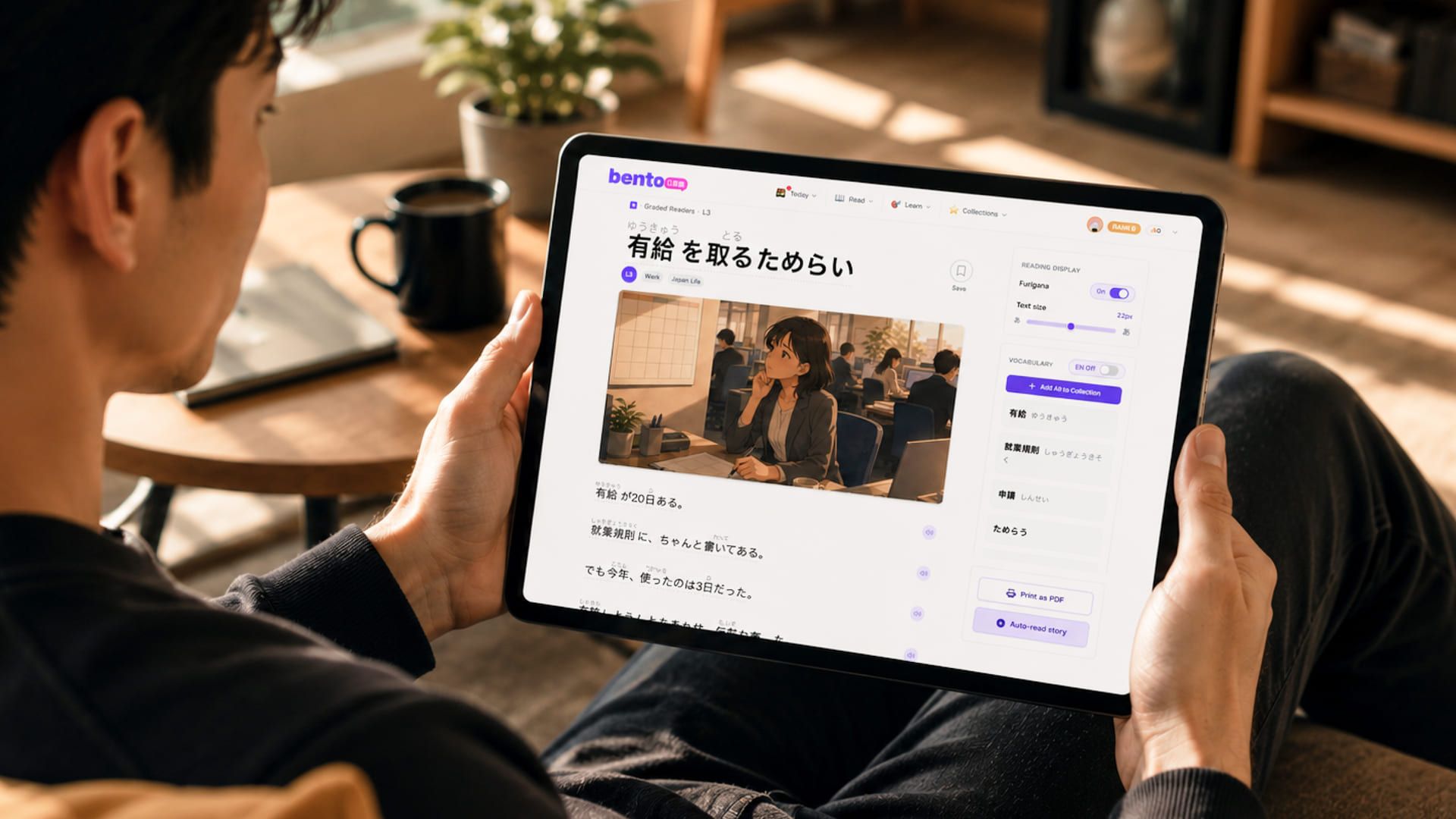
Finding the look
Getting the visual identity right took a few rounds. Early directions explored what you'd expect from a Japanese learning app: clean, minimal, a bit safe. We kept pushing until something clicked — a punchy purple and pink palette that felt confident without being loud, paired with clean typography that could carry both Japanese and English comfortably.
The bigger decision was around imagery. A lot of language learning brands lean into illustrated fantasy worlds or generic study visuals. We wanted Bento to feel grounded in actual Japan — the kind of Japan you'd encounter living here. The brand identity leans on photography: real places, real food, real life. It gives the content a sense of context that illustrations can't replicate.
The graded readers are a different story. Those are built around topics that often skew toward anime, light novels, and games, so the accompanying illustrations use a style that fits those references. It keeps the reading experience cohesive without making the whole brand feel like it belongs in a comic shop.

Building the graded reader library
The core of Bento is its graded readers: short articles written for learners at specific JLPT levels. Writing these means curating vocabulary and grammar appropriate to its level, having a topic people actually want to read about, and making it interesting enough to be worth finishing. Too simplified and it feels condescending; too complex and learners feel overwhelmed. We've been producing these steadily since the beginning.
Naming something that competes with lunchboxes
"Bento Japanese" came from the idea of small, manageable portions of learning — like a bento box. It fits the product well. The catch is that SEO tools are somewhat confused by it, since bento is also a very popular lunch item. It's something we've had to work around rather than solve cleanly. The name stays.
From web app to pocket
The web app came first. The iOS app launched in January 2026, partly as a new surface and partly because conversion rates on mobile tend to behave differently than on the web. The two now work together: learners can read on either platform, with vocabulary and progress carrying across.
The admin dashboard, sitting behind the scenes, handles content management and lets us keep iterating quickly without disrupting what's live.
Still in progress
Bento Japanese is live, and we're still actively building it. Over 1,000 users as of mid-2026, growing daily. New readers, new features, and improvements based on how people actually use it are ongoing.
Want results like this?
Tell us about your project.