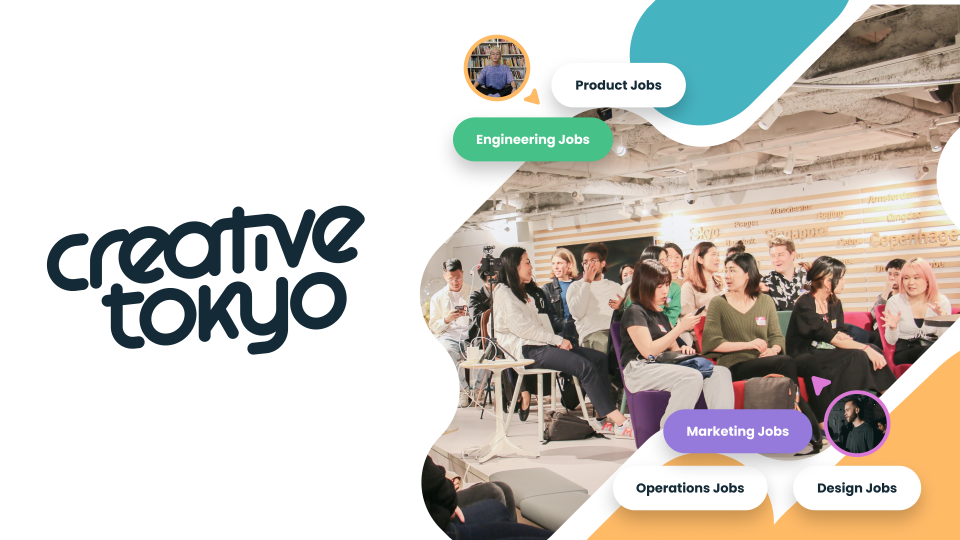
Creative Tokyo
4,300+
Members on Meetup
3,900+
Members on Slack
162
Guests at ADPList's first Japan event
A ten-person meetup grew into Tokyo's largest international creative community, now with a documented brand and a platform of its own.
Executive Summary
Mission
Making friends as a working adult is hard. School gives you a shared, consistent space, and once that's gone there's no default place to replace it. Creative Tokyo set out to be that place for creatives in Tokyo.
Outcome
A meetup that started in May 2018 as Tokyo Design became Creative Tokyo: a brand, a website, a job board, and a regular calendar of events. The brand now has proper guidelines, and the site has been rebuilt with a design system behind it.
Impact
Creative Tokyo is the largest international creative community in the city, with 4,300+ members on Meetup and 3,900+ on Slack, an award-winning job board, and collaborations with Daimler's Fuso brand, ADPList and Framer. Anyone making something for the community now has a brand to follow, and anyone building the next page has components to build it from.
There's no default place to make friends as an adult
Most ways of meeting people are built around something else: a job, a class, a conference. You show up to get something, trade business cards, and leave. Friendship rarely survives that.
Creative Tokyo was built to close that gap. Not a networking event where everyone is quietly sizing each other up, but a consistent space where creatives show up as themselves.
It started as a test for an app
The first gathering was about ten people in a Shibuya HUB. Hitomi had recently moved back to Tokyo, was short on designer friends, and wanted to test an app idea called Fether.
The app didn't last. The meetup did. It grew into bigger events, workshops, dinners and museum visits, and the community turned out to be the thing worth building.
From Tokyo Design to Creative Tokyo
"Tokyo Design" stopped fitting. It sounded like a design meetup, and by then the group included writers, developers, founders and illustrators. The rename to Creative Tokyo came with a logo, a visual language, and a tagline: "Create connections that last a lifetime."
The look had a job to do. It had to say this is a place to be a whole person and not a job title, so it leaned warm and a little playful instead of professional in the LinkedIn sense.
Ideathons with Fuso
One of the earliest collaborations was with Daimler's Fuso truck brand, on innovation in a business most people never think about. Creative Tokyo opened its community to the public and ran full-day ideathons that put outside creatives in a room with Fuso employees.
The mix was the point. Outsiders brought ideas from other industries, employees brought the context, and every team pitched at the end with rough prototypes, some of them built from Lego.
Bringing in the people members wanted to meet
As the community grew, so did the people it could bring in. An AI and Creativity event brought in University of Chicago professor Ben Zhao, joining remotely, for an open forum on generative AI, with Hitomi moderating. ADPList's first Japan event was hosted with Creative Tokyo and drew 162 guests, joined by co-founder and CEO Felix Lee. Framer came on for the 2024 year-end bounenkai and a fireside chat on the year in web design.
Same shape every time: a real conversation, then a mixer where the connecting happens.
A job board that places people
When one member is looking for work and another is hiring, the relationships are already there. The job board grew out of that, and it has quietly placed people into roles across Tokyo.
The feedback isn't about volume, it's about fit. Hires arrive already understanding the work, because they come from a community organized around it.
Thanks to Creative Tokyo, I was able to obtain a position in Tokyo. I wouldn't have gotten this job without your community. — Gloria R.
I landed the job a few days before my visa expired! Hopefully others also benefit from the wonderful support from Creative Tokyo. — Nikhil B.
Their network has been invaluable in finding the right people with the right skills. Working with talented people who understand our mission has been a true pleasure. — Bilal Kharouni, ekei labs
4 people reached out to me and we hired one of them! It was really helpful, thank you! — Haruka Minamino, Genesis Healthcare
Thanks to you I found a GREAT designer to help us. She reached out after you posted in the group, and she's an awesome addition to our team! — Raphael Hodé, kammeko
Recognition for the model
In July 2021, Creative Tokyo pitched at Social Change Makers #4, an accelerator run by ImpacTech Japan with support from The Nippon Foundation, and won the Best Performance Award. The award was for what the community had been doing informally for years: using creative connection to help people find work, and each other.
Writing the brand down
For years the look came together as it was needed: a logo, a few colors, some event banners. It worked, but nothing was written down, so anything made outside the core team drifted.
The 2025 guidelines fixed that. They open with the mission, "Create Connections That Last a Lifetime," and six principles, starting with human-first connection over transactional networking.
The visual half is built for a group that makes a lot of graphics: Figtree for type, a palette of navy, blue and yellow, and soft blob shapes that hold member portraits.
A site to use, not just read
The old site described the community. The new one is something to use, with a job board and a blog, and more in development.
It moved to the stack we build on now, SvelteKit, Vercel, Supabase and Sanity, so the team can post jobs and articles themselves and keep adding to the site without rebuilding it. It also carries the new brand, from the hero line, "The Coolest Creatives You'll Meet in Tokyo," to the blob-masked portraits of real members.
A design system so the next page is quicker
Pages get built in bursts, often by whoever is free that week, so the site needed a shared kit. Tokens came first, for color, type, spacing, radius and shadows, then the components that sit on them.
It lives at creativetokyo.com/design-system. It is what keeps the tenth page looking like the first.
Friendship first
Underneath it all is an unfashionable idea: friendship first. Professional networking usually runs the other way, treating people as means to an end and hoping something warmer happens by accident. Connect as people first, and the careers, partnerships and businesses follow.
A little cheesy, and that's fine. Years in, Creative Tokyo is an easy place to find a new creative friend in Tokyo, which was the whole point.
Want results like this?
Tell us about your project.