
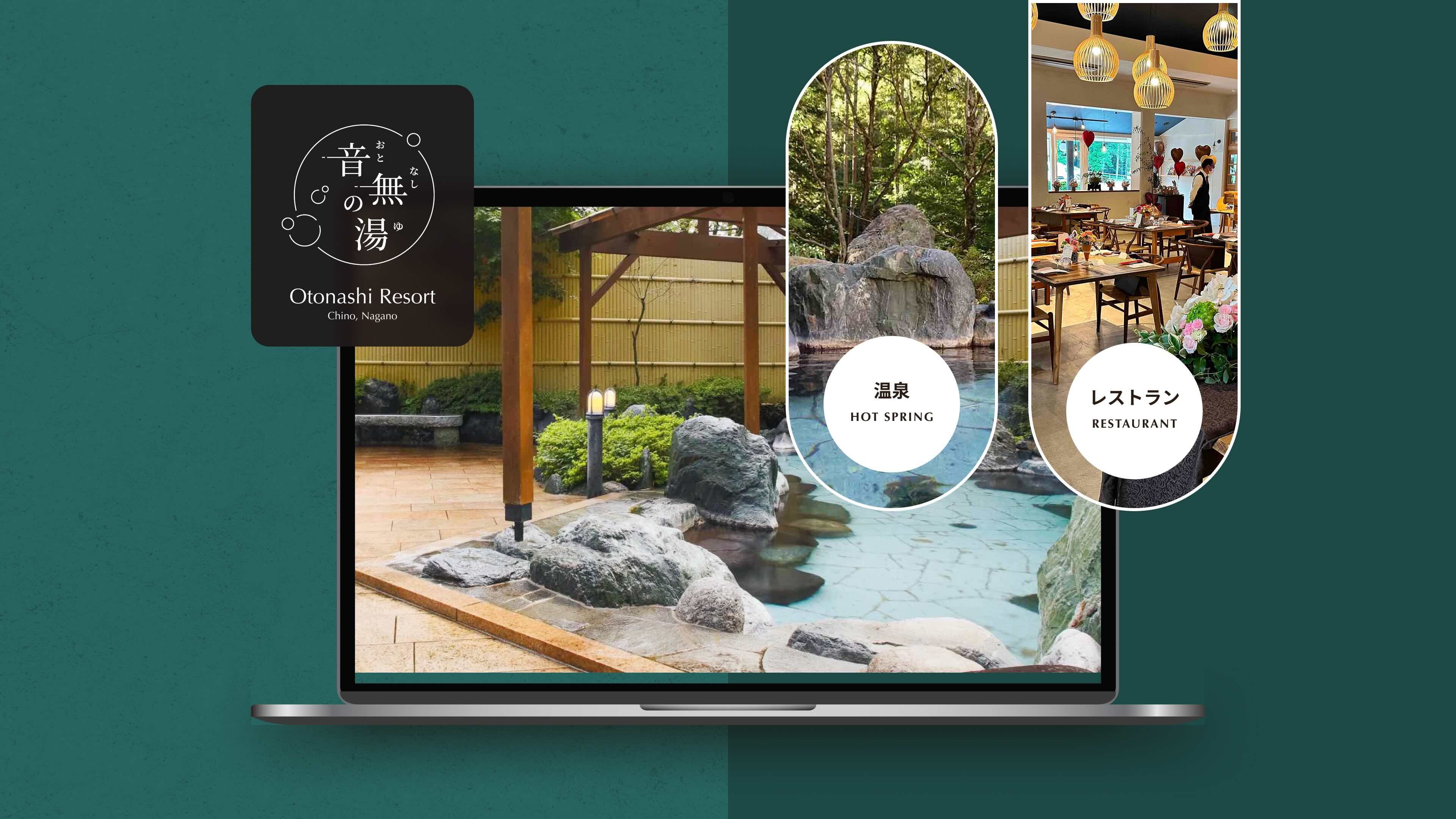
Otonashi no Yu
A Japanese and English site whose opening hours, closures and seasonal news are driven by the owners' own Google Calendar, so the details visitors rely on stay current without a developer in the loop.

Executive Summary
The Mission
Otonashi no Yu is a day-use hot spring and farm-to-table restaurant on the road that climbs from Chino toward Lake Shirakaba, in Nagano's Tateshina hot spring area. The business changed hands, and the website came with it. What the new owners wanted was a site they could keep up to date themselves — because at a place like this, the details a visitor most needs are the ones that change week to week.
The Outcome
A bilingual landing page, Japanese and English, designed and built in Framer. Opening hours, closures and seasonal news are served from the owners' own Google Calendar, embedded directly in the page.
The Impact
Hours and closing days are now set by the people who decide them, in a tool they already open every day. A change to the calendar shows up on the site immediately, in both languages.
A hot spring partway up the mountain
Otonashi no Yu sits at 2977-1 Kitayama, on the Daimon Pass road between Chino Station and Lake Shirakaba. Its outdoor bath is fed by a carbonate-rich spring that runs straight through and out again, and the restaurant next door cooks with produce from Tateshina growers. There is also a tofu maker on site, Tateshina Kamo Shichi, working each morning with well water drawn from the same ground as the spring.
It is the kind of place people stop at on the way to somewhere else, or drive up to specifically, and either way they check one thing before setting off: is it open today.

The detail that's hardest to keep right
Opening hours here are not a fixed grid. The baths and the restaurant keep different schedules, the restaurant's last order moves, and closing time can come earlier than posted depending on how many guests arrive near the end of reception. On top of that sit the regular Tuesday and Wednesday closures, seasonal changes, and the occasional one-off.
That is a lot of small, frequent edits — and exactly the sort of thing that quietly goes stale on a website while remaining perfectly accurate in the owners' heads.
Pointing the site at a calendar they already keep
Rather than build an hours module for the owners to learn, the site was pointed at the Google Calendar they were already maintaining. The Hours button opens that calendar embedded in the page, set to Asia/Tokyo, reading from the account the staff use day to day.
The same thinking covers the restaurant menu, which links out to a PDF in the owners' Drive. Neither of these needs a login to the site, a CMS, or a message to anyone. The owners update the thing they were already updating, and the page follows.
Two languages, one road
The site runs Japanese at the root and English at /en, for two audiences arriving by quite different routes — domestic visitors driving up from Chino or over from the Shirakaba resorts, and international travellers working their way around the Tateshina and Yatsugatake area.
The two versions carry the same structure rather than one being a trimmed-down copy of the other. Bathing fees, amenities, the tofu shop and the access details are all present in both.
Where it is now
Beyond hours and prices, the page closes with what is nearby and how long it takes to reach — Lake Shirakaba nine minutes by car, Kurumayama Highland fourteen, Otome Falls fifteen, the North Yatsugatake Ropeway twenty-five — each with a public-transport time alongside the driving one. For somewhere that sits between destinations rather than at one, that framing treats the visit as one stop in a day out, which is how most people actually arrive.
The site is live at otonashinou.com in both languages. The owners publish their own hours, closures and seasonal notes, and the page reflects them as they go.

Want results like this?
Tell us about your project.